














No matter what your profession or general interests, you’ve probably had occasion to reach for a mallet at least once in your life. After all there are tasks that deserve a little more finesse than an outright wallop. Well, sometimes there are shades of finesse as well, right? Pounding a tent stake into the ground is a whole lot different than gently nudging a doweled joint together. Obviously, one can look at the size of the head – Halder mallets range from 30 mm (just a little over an inch) to 140 mm (5.5”) – but more subtle differences can really affect the suitability of the tool for different tasks.
The Halder Simplex mallet design was the first innovation by Erwin Halder way back in 1938. By breaking the mallet down into a system of three H’s: handle, housing and heads (or inserts), he created not only a tool that was flexible in its implementation but also opened the possibility of replacing parts as they wore or broke: with only a few exceptions all of the Halder Simplex mallet parts can be purchased individually.

The key to this design is the housing. Built like a clamshell with a single hex fixing bolt, opening it up allows access to the two inserts as well as the handle. The conventional design is cast iron, which is built to hold up under a lifetime of pounding, but there is also a heavy-duty version, which features extra reinforcing ribs and contributes extra weight to every swing. For overhead work or just a general lighter touch, there is also a cast aluminum version. In all versions the housing extends down onto the handle for extra reinforcement.

And moving on to the handle, there are also a couple of options. The standard handle is made of acacia, which is dense and durable, while offering some vibration dampening. Two coats of varnish ensure some resistance to sweat and water, while making it easy to clean. For many of the longer-handled or heavier mallets, hickory is used, as its dense and long fibers are naturally resistant to breakage. Finally, for the ultimate in durability and shock resistance, some of the hammers feature a fiberglass handle. (Use only in the heavy-duty housing!)

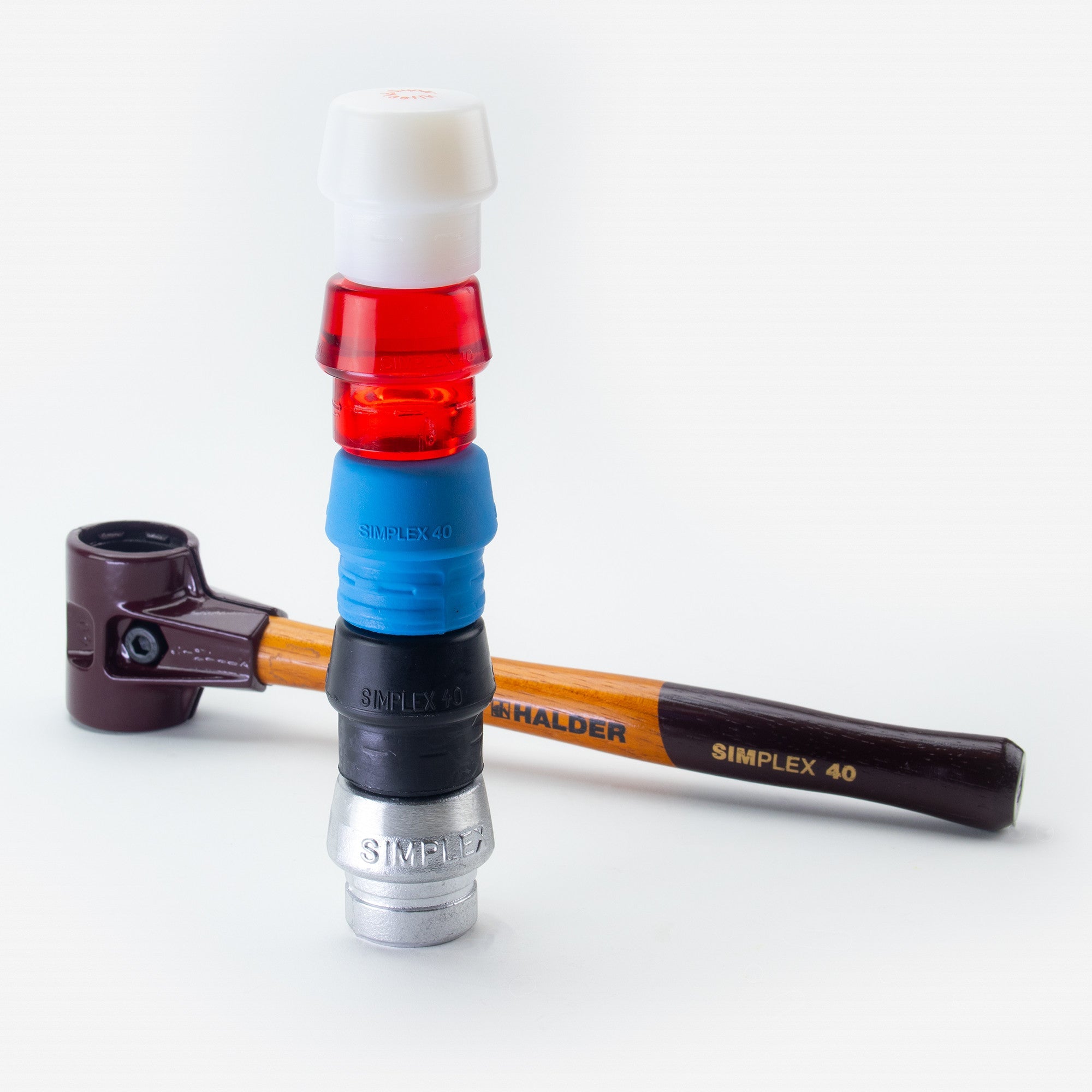
Now for the fun part. There are a wide range of inserts available, and, of course, having two heads to each mallet allows the possibility of combinations of heads on each hammer. Materials range from softer Thermoplastic Elastomers (TPE) to harder plastics and up to aluminum and copper. The TPE heads are (from softest to firmest) blue, gray and black and offer the most impact cushioning – not only to give just a soft nudge to your project, but also to protect against dents, and in the case of the blue and gray inserts, to prevent any surface marks from the head material. Think wood joinery, tile and masonry work, or window and door installation.
Next the plastic heads: superplastic, red acetate and nylon. They are the workhorses, and being extruded plastic, are very dense, durable and resistant to chipping and splitting. Also being oil- and grease-resistant, they are perfect for mechanics of all stripes. Examples of applications would be scaffold and tent installation, driving wood and steel wedges and stakes, landscaping, and roofing.
Finally, the real persuaders. Aluminum and copper are the hardest inserts and are perfect where you really need to apply some real impact to your work at hand. Maintenance and repair projects, sheet metal work, and loosening metal parts are just some of the possible uses for these heads. Just remember that the hardest insert, copper, can only be used in cast iron housings.
The Simplex system can be a bit bewildering in its array of choices, but a little thought about your most common work can easily narrow down your choices. And the replaceable insert design allows for easy experimentation. Try Zach’s Happy Hammer Set for an introduction into the differences in insert materials.


